
Look who rolls fast
- In stock with stable lead times — single units or complete sets
- Size, appearance and interaction can be adapted to the museum’s theme
- For science museums, campus science rooms, community science centers and mobile science museums
- Export packing and overseas on-site installation support
Exhibition Description
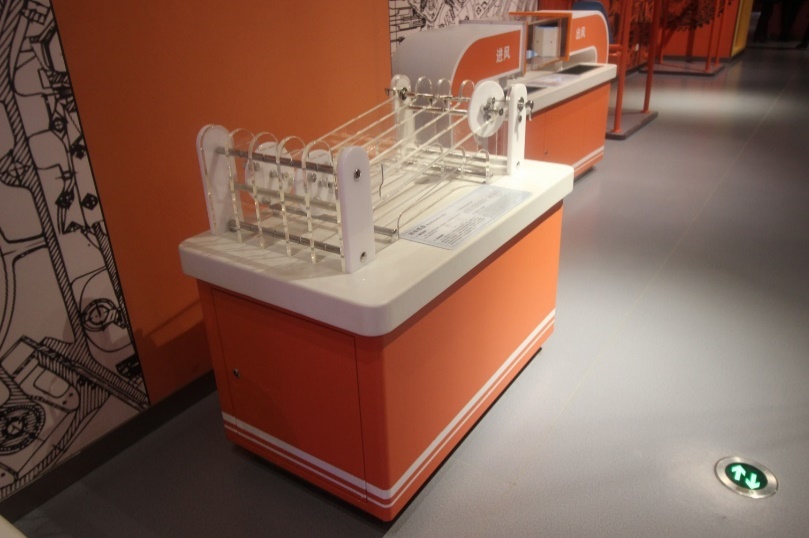
Exhibitions consist of exhibition booths, tracks, and rollers. Three wheels of the same shape are of equal size and mass, but with different mass distributions. When participants participate in exhibition items, they place them at the starting point and, under the influence of gravity, both rollers roll down from the high end to the low end simultaneously, observing the rolling results of the rollers.
Presentation format and purpose
Exhibition items showcase wheels with the same diameter and mass but different mass distributions rolling down the same track at the same time, but reaching the bottom at different times, in order to stimulate the audience's thinking about the relationship between rotational inertia and mass.
Exhibition Content
The moment of inertia is a measure of the inertia of a rigid body when it rotates around an axis, represented by the letters I or J. In classical mechanics, the moment of inertia is usually expressed as I or J, and the SI unit is kg · m ². For a particle, I = mr², Where m is its mass and r is the vertical distance between the particle and the axis of rotation. The role of moment of inertia in rotational dynamics is equivalent to mass in linear dynamics, which can be formally understood as the inertia of an object towards rotational motion, used to establish relationships between several quantities such as angular momentum, angular velocity, moment, and angular acceleration.
The moment of inertia is a physical quantity that represents the magnitude of the rotational inertia of a rigid body, which is related to the mass of the object and its distribution relative to the axis of rotation. The speed at which an object rolls is directly related to the weight distribution around its center of gravity. This weight distribution is also known as moment of inertia. The smaller the moment of inertia, the faster the object rolls. The moment of inertia of an object is determined by three factors: mass, mass distribution, and axis position.
Exhibition operation process
Exhibition dimensions
length width height
Overall size 1.2 0.7 1
exhibits composition
1. Main Material List:
Main component names, main materials, processing techniques
Platform components: artificial stone+flame-retardant wood board+Q235A board+Q235A square tube carving machine cutting, artificial stone hot bending; Laser cutting, sheet metal bending, rust prevention, paint baking
Q235A bracket sheet metal bending, rust prevention, paint baking
Clear acrylic engraving machine for instruction board cutting, UV printing
Roller transparent acrylic+stainless steel laser cutting
Rail stainless steel/
Environmental Requirements
Category requirements
Ground bearing capacity of 400Kg/m2
Electricity consumption: None
Do you need water supply and drainage □ Water supply □ Drainage □ Water supply and drainage
Do you need to connect to the network? □ Yes No
Ordinary lighting is required for ambient light
Daily Management
Open all day, no need for dedicated personnel to guard, but requires supervision.
repair and maintenance
Regular maintenance.
Related exhibits
These come from the same product line, so they can be combined into one gallery — dimensions, colours and interaction level specified to match.

活塞连杆传动机构
Mechanics and Machinery
马德保半球
Mechanics and Machinery
羽毛与小球
Mechanics and Machinery
针幕 科技馆科教互动展品定制
Mechanics and Machinery
伯努利原理-听话的小球
Mechanics and Machinery
陀螺转椅
Mechanics and MachineryNeed to combine these into one gallery? Send us the floor plan and we will return a layout and a price. Request a layout