
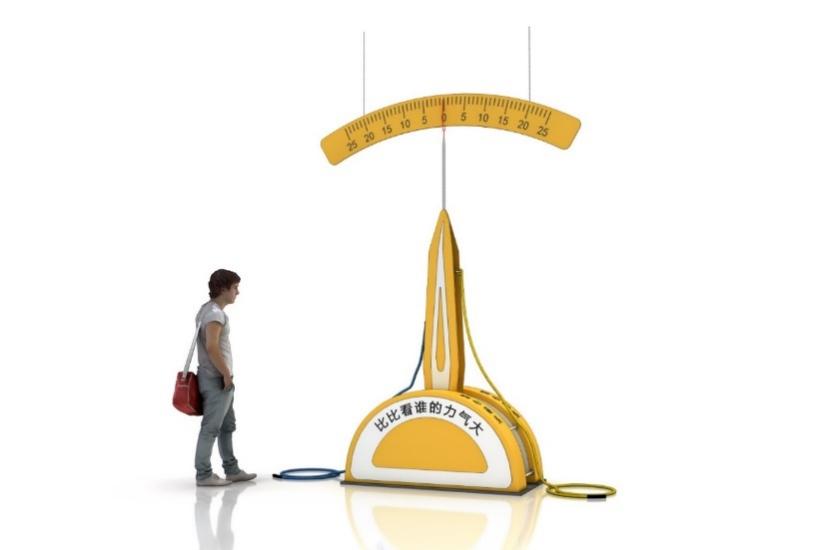
The victory of the weak
- In stock with stable lead times — single units or complete sets
- Size, appearance and interaction can be adapted to the museum’s theme
- For science museums, campus science rooms, community science centers and mobile science museums
- Export packing and overseas on-site installation support
Exhibition Description
The exhibition items are designed as a vertical stand resembling clock hands, consisting of pointer models, ropes, rulers, etc. Set poles on both sides of the pointer, and connect a rope with adjustable position to each pole. During interaction, both parties adjust the position of the rope and then grab the ropes at both ends to participate in a tug of war competition. Observe the angle change indicated by the needle tip above and try adjusting the position of the rope multiple times for the competition.
Presentation format and purpose
Exhibition items are presented in the form of tug of war games, allowing the audience to learn about the principles of leverage.
Exhibition Content
lever principle
The principle of leverage is also known as the "leverage equilibrium condition". To balance the lever, the two moments acting on the lever (the product of the force and the arm) must be equal in magnitude. Namely: Power x Power arm=Resistance x Resistance arm, expressed algebraically as F1 · L1=F2 · L2. In the formula, F1 represents power, L1 represents power arm, F2 represents resistance, and L2 represents resistance arm. From the above equation, it can be seen that in order to achieve balance of the lever, the power arm is several times that of the resistance arm, and the power is a fraction of the resistance.
How can we win the game more easily?
In tug of war competitions, two ropes are not the two ends of the same rope, but two independent ropes that are threaded at different heights on the "big pointer". According to the principle of leverage, in order to balance the lever, the two moments acting on the lever (the product of the force and the arm) must be equal in magnitude. That is, power x power arm=resistance x resistance arm, so pulling the side of the rope located at a higher position (with a longer force arm) can easily win pulling the side of the rope located at a lower position (with a shorter force arm).
Exhibition operation process
Exhibition dimensions
length width height
Overall size 1.8 0.4 3
exhibits composition
1. Main Material List:
Main component names, main materials, processing techniques
Q235A board for platform components+stainless steel laser cutting, sheet metal bending, rust prevention, and baking paint; Lathe, milling machine
Pointer Q235A board laser cutting, sheet metal bending, rust prevention, paint baking
Acrylic engraving machine for dial cutting, UV printing
Pulling rope nylon rope/
Environmental Requirements
Category requirements
Ground bearing capacity of 400Kg/m2
Electricity consumption: None
Do you need water supply and drainage □ Water supply □ Drainage □ Water supply and drainage
Do you need to connect to the network? □ Yes No
Ordinary lighting is required for ambient light
Daily management: Open all day, no need for dedicated personnel to guard, but requires supervision.
Maintenance: Regular maintenance.
Related exhibits
These come from the same product line, so they can be combined into one gallery — dimensions, colours and interaction level specified to match.

混沌水车
Mechanics and Machinery
比扭力
Mechanics and Machinery
水漩涡
Mechanics and Machinery
万有引力
Mechanics and Machinery
水池
Mechanics and Machinery
飞绳 飞舞的绳子
Mechanics and MachineryNeed to combine these into one gallery? Send us the floor plan and we will return a layout and a price. Request a layout