
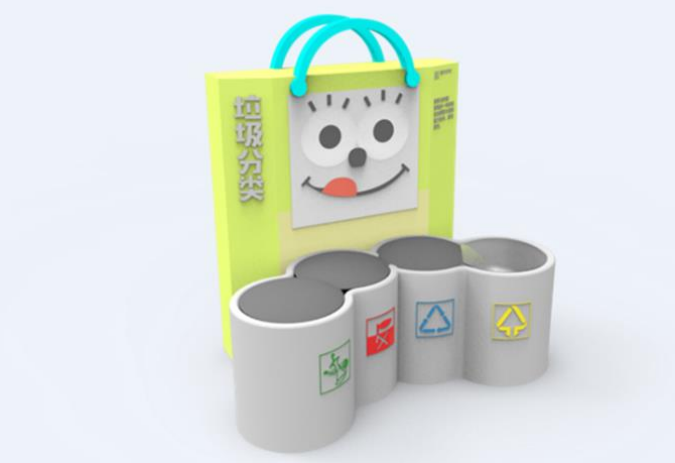
garbage classification
- In stock with stable lead times — single units or complete sets
- Size, appearance and interaction can be adapted to the museum’s theme
- For science museums, campus science rooms, community science centers and mobile science museums
- Export packing and overseas on-site installation support
Exhibition Description
The exhibition items consist of four induction booths in the shape of garbage bins and a wall mounted television. When in standby mode, the TV plays videos related to the importance of garbage sorting. When the audience presses any garbage bin lid, the game starts. After the demonstration and countdown, the TV enters the interactive quiz. Based on their own judgment, the audience presses the lid of the garbage bin to sort the garbage. If selected correctly, the trash in the TV will disappear and the next trash will appear; If the selection is incorrect, a prompt will appear to reselect.
In the 120s interactive game, participants need to quickly identify the types of garbage appearing in the screen. After the countdown ends, the accuracy will be announced, and titles such as "Environmental Protection Guardian" and "Environmental Protection Expert" will be evaluated according to their accuracy.
Presentation format and purpose
Exhibition items is a multimedia interactive project where participants deepen their impression of various types of garbage classification by selecting the category of garbage. Through the game, they unconsciously learn about the classification standards of garbage, correctly identify garbage categories, and cultivate the habit of garbage classification.
Exhibition Content
1. What is garbage classification
Garbage classification generally refers to a series of activities that classify, store, dispose of, and transport garbage according to certain regulations or standards, in order to transform it into a public resource. The purpose of classification is to enhance the resource and economic value of garbage, strive to make the best use of resources, reduce the amount of garbage treatment and the use of treatment equipment, lower treatment costs, and reduce the consumption of land resources. It has social, economic, ecological and other benefits.
2. Garbage classification method
a. Recyclable waste mainly includes five categories: waste paper, plastic, glass, metal, and fabric. These wastes can be comprehensively processed and recycled to reduce pollution and save resources.
b. Kitchen waste: including leftover food, bones, vegetable roots, leaves, fruit peels, and other food waste that can be processed and composted on-site using biotechnology. Each ton can produce 0.6-0.7 tons of organic fertilizer.
c. Hazardous waste refers to waste that contains heavy metals, toxic substances that are harmful to human health, or waste that poses real or potential environmental hazards. Including batteries, fluorescent tubes, light bulbs, mercury thermometers, paint buckets, household appliances, expired drugs, expired cosmetics, etc., they generally need to be separately recycled or landfilled.
d. Other garbage: including difficult to recycle waste such as bricks, tiles, ceramics, slag, bathroom waste paper, tissues, etc., which are usually disposed of by incineration or landfill according to the characteristics of the garbage.
Multimedia Script Outline
Content of the superior operation screen on the serial number interface
1. There is no standby interface available Title: Garbage Classification 2 Screen composition: Video+Operation instructions Video: Play the video, explain the importance of garbage classification and demonstrate dangerous goods Operation instructions: Press the garbage can lid to open the game, test whether you are an environmental protection expert!
2. Demo interface: Place your hand on top of any trash can. 1 Title: Garbage Classification 2 Screen composition: Interactive guide+operation instructions Interactive guide: explain in animation or graphic form how to select options Operation instructions: press any trash can lid to enter the game.
Place your hand on the top of any trash can on the countdown interface Title: Garbage Classification 2 Screen composition: Countdown Countdown Countdown: 3, 2, 1 go!
4 Interactive interfaces without 1 Title: Garbage Classification 2 Screen composition: Countdown, number of answers, garbage pictures, prompt pop-up countdown: 120s countdown in the upper left corner of the screen Answer count: number of correct answers per question in the upper left corner of the screen+1 Garbage picture: garbage picture and name in the middle of the screen, replacement prompt pop-up: garbage classification selection error, pop-up: selection error, please choose again!
The countdown on the 5 result interface has ended Title: Garbage Classification 2 Screen composition: Result popup Result popup: Number of answers and titles obtained. Note: The result popup will automatically return to standby mode after 20 seconds, or the audience can press the trash can lid to return to standby mode.
Exhibition operation process
Exhibition dimensions
length width height
Overall size 1.65 1.1 1.8
exhibits composition
1. Main Material List:
Main component names, main materials, processing techniques
Operation booth cold-rolled low-carbon steel plate+30 # square tube+artificial stone countertop rust prevention and baking paint
2. Main equipment list:
Name, Specification, Unit, Quantity
TV size: 42 Screen resolution: 1920 * 1080 Screen ratio: 16:9 1
Computer CPU: i5 Memory: 8GB Hard Disk: 128GB Solid State Drive Graphics Card: 4G Single Display Desk 1
Customized set of electromechanical control system 1
Environmental Requirements
Category requirements
Ground bearing capacity of 400Kg/m2
Electric power consumption 220V/6000W
Do you need water supply and drainage □ Water supply □ Drainage □ Water supply and drainage
Do you need to connect to the network? □ Yes No
Environmental light demand natural light
Daily Management
1. Open all day, no need for dedicated personnel to guard, but requires supervision;
2. Automatically turn on when powered on, automatically turn off when powered off.
Maintenance: exhibits are equipped with access doors and universal triangular locks for opening and closing.
Related exhibits
These come from the same product line, so they can be combined into one gallery — dimensions, colours and interaction level specified to match.

谁的韧性好
Life and Health
透视消点错觉模型
Life and Health
追踪挑战
Life and Health
谁的动作准
Life and Health
倾斜小屋
Life and Health
知冷知热
Life and HealthNeed to combine these into one gallery? Send us the floor plan and we will return a layout and a price. Request a layout