
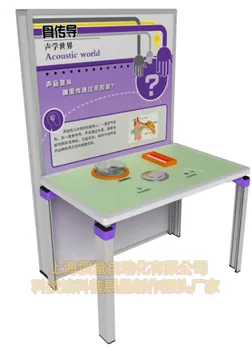
bone conduction
- In stock with stable lead times — single units or complete sets
- Size, appearance and interaction can be adapted to the museum’s theme
- For science museums, campus science rooms, community science centers and mobile science museums
- Export packing and overseas on-site installation support
Exhibition size: 1.20 * 0.91 * 1.80 (m)
Operating instructions: 1. Press the "Auto Play" button or the "External Sound Source" button to insert the audio connector into the built-in sound source; 2. Choose a small stick and stand it between the disc and the earlobe, listen carefully; 3. Place one elbow on the disc, cover your ears with your hand, and listen carefully. Function Overview: Exhibition items consist of conductive rods made of different materials, music players, resonant speakers, external sound source sockets, etc. Press the "External Sound Source" button, insert the audio connector into the built-in sound source that is currently playing music, or press the "Auto Play" button, and then select a participation method: 1 Select a conductive rod, place one end at the center of the interactive area disc and the other end close to the ear, and listen carefully; 2. Place your elbow at the center of the interactive area's disc and cover your ears with your palm to hear the sound. Scientific principle: 1. How is sound transmitted to your ears? 2. Do different sticks sound the same? Sound is generated by the vibration of objects, and its propagation requires a medium. Any solid, liquid, or gas can propagate sound and ultimately transmit it to the auditory nerve in the cochlea. The auditory nerve then transmits the signal to the brain, and we hear sound. The materials of the small sticks in exhibitions are different, and the sound heard is not completely the same. Another method is to transmit sound to the cochlea through the bones and skull of the arm. When we speak ourselves, the sounds we hear are mainly transmitted through our skulls; When listening to others speak, the sound vibrates through the air, causing the eardrum to vibrate.
Everyone go back and try recording your own voice to listen. Is it the same as the sound you hear when you speak directly?
1. Main configuration of materials for exhibitions:
① PLC control system: FX2N-32MR output input form: relay output; Total number of inputs: 16 points; Total output: 16 points; Expansion: possible; Working power supply: DC 24V ② Switching power supply: Mingwei NES-35-24 input AC220V, output DC24V, power 35W ③ Leakage switch: Chint DZ47LB-32 C16 poles: 2P+N; Release current: 16A; arc extinguishing medium: residual current circuit breaker; Breaking capacity: 6KA ④ Horn: Resonant horn 50W ⑤ Button: Red wave button GQ25-11E Installation hole size Φ 25; Working voltage 250V; Working current: 5A; Rated heating current: 10A; Mechanical lifespan: 1 million cycles; Head protection level: IP65; Protection method: Waterproof. Energy demand: AC220V 200W 2. Main configuration of booth materials: ① Booth: Customized irregular surface sandblasted aluminum parts, aluminum alloy profiles, bi-directional plug injection molded parts ② Tabletop: 12mm ceramic panel (white), 16mm wooden board, injection molded tabletop edge ③ Instruction board: Customized aluminum alloy skeleton, 8 injection molded part connections, 5mm solid wood board, 3mm aluminum board, bright photo on the surface of the wooden board, transparent acrylic polished and UV painted ④ Tabletop fixing parts: Powder coated die-casting aluminum parts, national standard connectors and fasteners
Video demonstration explanation:
Related exhibits
These come from the same product line, so they can be combined into one gallery — dimensions, colours and interaction level specified to match.

最速降线
Campus Science Museums
水上隧道
Campus Science Museums
喊泉 科技馆儿童科学乐园戏水天地
Campus Science Museums
双曲线槽
Campus Science Museums
制造漩涡
Campus Science Museums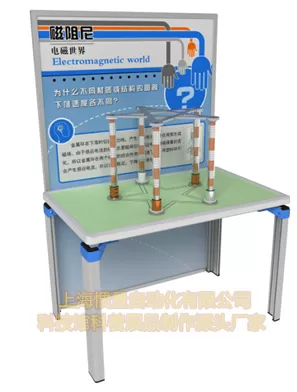
磁阻尼
Campus Science MuseumsNeed to combine these into one gallery? Send us the floor plan and we will return a layout and a price. Request a layout