
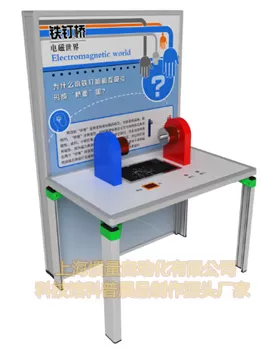
Iron nail bridge
- In stock with stable lead times — single units or complete sets
- Size, appearance and interaction can be adapted to the museum’s theme
- For science museums, campus science rooms, community science centers and mobile science museums
- Export packing and overseas on-site installation support
Exhibition size: 1.20 * 0.91 * 1.80 (m)
Operating instructions: 1. Press the "power on" button to start the timer; 2. Connect the left and right "bridge piers" with small iron nails within the specified time and build the "bridge deck"; 3. Press the 'power off' button and observe the phenomenon. Function Overview: Exhibition items consist of a bridge pier made of two electromagnets and several iron nails. The experiencer presses the power button, and the digital display starts counting down. The experiencer needs to use iron nails to complete the overlapping of the bridge deck within the set time. When the time is up, the electromagnet will automatically power off, or the electromagnet can be directly turned off by pressing the power off button. Scientific principle: Why can small iron nails attract each other to form a "bridge deck"? The "bridge piers" on both sides are iron cores with coils wound on the surface, which are electromagnets. When there is a power outage, the "bridge pier" does not have magnetism, but when the coil is energized, the iron core in its middle becomes magnetic. At this moment, when the small iron nail approaches the "bridge pier", it will be attracted by it and also become magnetic. Because magnetic force has the characteristics of repulsion between poles and attraction between poles, iron nails can be connected end-to-end between two "bridge piers" to form a "bridge deck". The phenomenon in which these iron cores and nails, which originally did not have magnetism, exhibit magnetism under the action of a magnetic field is called magnetization.
Electromagnetic suction cups, solenoid valves, etc. all utilize magnetization. You can also try using a small magnet to magnetize the sewing needle and make a simple compass.
Main configuration of materials for exhibitions:
Protective cover: colored acrylic electrical main configuration: ① ① PLC control system: FX2N-32MR output input form: relay output; Total number of inputs: 16 points; Total output: 16 points; Expansion: possible; Working power supply: DC 24V ② Switching power supply: Mingwei NES-35-24 input AC220V, output DC24V, power 35W ③ Leakage switch: Chint DZ47LB-32 C16 poles: 2P+N; Release current: 16A; arc extinguishing medium: residual current circuit breaker; Breaking capacity: 6KA ④ Button: Red wave button GQ25-11E Installation hole size Φ 25; Working voltage 250V; Working current: 5A; Rated heating current: 10A; Mechanical lifespan: 1 million cycles; Head protection level: IP65; Protection method: Waterproof. ⑤ Electromagnetic coil: self-made ⑥ Digital display: self-made Energy demand: AC220V 2000W Booth materials Main configuration: ① Booth: customized special-shaped surface sandblasted aluminum parts, aluminum alloy profiles, two-way plug injection molded parts ② Tabletop: 12mm ceramic panel (white), 16mm wooden board, injection molded table edge ③ Instruction board: customized aluminum alloy skeleton, 8 injection molded parts connected, 5mm solid wood board, 3mm aluminum board, wood board surface bright photo, transparent acrylic polished and UV painted ④ Tabletop fixing parts: die-casting aluminum parts powder coated, national standard connecting parts and fasteners
Video demonstration explanation:
Related exhibits
These come from the same product line, so they can be combined into one gallery — dimensions, colours and interaction level specified to match.

雅各布天梯
Campus Science Museums
跳舞的回形针
Campus Science Museums
水上隧道
Campus Science Museums
人体发声
Campus Science Museums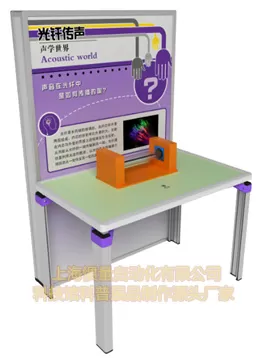
光纤传声
Campus Science Museums
阿基米德螺旋泵
Campus Science MuseumsNeed to combine these into one gallery? Send us the floor plan and we will return a layout and a price. Request a layout